Friday, November 01, 2019

Music Metaphor #1 - Driving over Potholes

  When one is driving a car down the road, occasionally there will be potholes in the path. If you are lucky, you can see it coming and avoid driving over it. Should you drive over the pothole, do not hit the breaks or turn the wheel suddenly, just continue driving. Most of the time, you and your vehicle will be just fine and you may continue driving as if nothing happened. Occasionally, the pothole is large enough that it could cause some damage...a blown tire, or damage to the shocks. You may still be able to drive, but you will want to work on fixing those issues as a top priority. Under no circumstances is it necessary for you to stop the car, back up and try to avoid the pothole in a second attempt. It is best to continue driving and stay aware of any upcoming potholes.

Now, do the same when you perform music. The road is the music you are playing, the instrument is your car, and the potholes are the inevitable mistakes. When you make a mistake, keep playing. Stay straight, focused on staying in the music and moving forward. If the mistake is so bad it knocks you out of the flow of the music, you need to address it and keep playing, but remember that the music itself does not change course or stop flowing. Learn to stay in the flow of music no matter what potholes come your way. As you keep driving forward, you will get better at avoiding potholes, and not letting mistakes knock you off our path. 

The Students I Teach

The students I teach are:
young.
old.
in highschool.
going to the university.
post-docs.
scholars.
doctors.
engineers.
professional musicians.
beginning musicians.
immigrants.
in the US on a visa.
growing up in the city they were born in.
never went to school.
homeschooled.
adopted.
transient.

The students I teach have...
survived cancer
had suicidal thoughts
transformed their identity
never considered themselves musicians.
always considered themselves musicians.
struggled with severe anxiety.
survived the loss of a loved one.
trouble sleeping at night.
considered being a rock star.
tried and failed many times before.
refused to give up.

The Students I teach possess...
desire
passion
fear
confidence
good ideas
bad ideas
doubts
creativity
potential

If there is one thing I have learned from every student I teach is that I have something to learn from every student I teach.

Tuesday, January 10, 2017

Soundtrap - Game Changing Technology for Music Education, Collaboration and Creation

  Adopting new technology for a music program is an exciting and daunting process.  I have always been fascinated with the fact that all of these amazing technologies exist all around us, yet the issues with implementing them have always been the same...What's the learning curve? How much does it cost? Will it work on our devices? Does it provide a safe environment for my students? Is it really worth all the trouble?!?
  For the last decade, I've logged more false starts, miss-steps and troubleshooting hours than I care to admit and I have worked hard to find solutions that allowed my students to learn, be creative, collaborate and share their work. I am happy to say that I have found a program that has delivered to me a simple solution that has opened the floodgates of creativity and collaboration in my music program, while at the same time freed up my time and allowed me to work on a much more substantive level with more students than ever before. (Yes, it is that good!). The solution is Soundtrap.com
  Soundtrap has been one of the most useful, impactful, simple and productive tools I have ever adopted in my classroom.  It is a fully online, multi-track recording application that has tools for (COPPA compliant) collaboration, creating original music using both loops and live recording, and a whole bevy of effects and sound 'enhancers', and integration with other apps like Google Classroom and Groove Pizza.  We have used Soundtrap to record our live concerts, voice overs for video, original music by Lower Elementary students, rehearsals, and concert announcements. As a teacher, I have used the loops to teach lessons on structure, chord progressions, effects (reverb, compression, equalization, etc.).
  I can not overstate how much this application has enhanced not only the music program, but the entire community at our school.  In the past, I spent a lot of time making sure the computers were up to date, the programs were compatible, and the storage of files was organized and students had a finite time and place that was available for them to work on their music, however, Soundtrap has taken all of those barriers away.  In addition, it is very user friendly.  I have students tell me all the time how much easier Soundtrap is to use than a program like Garage Band.  The collaboration feature is really what gets the students excited. They love to start a session, invite their friends, (and sometimes even their teacher), and get to work.  They play their music for each other on their personal devices, share them through e-mail, and submit them to be part of our end of the year school-wide album.
  Soundtrap works on any device that has an internet connection and I have even been able to connect it to our fancy DAW's with little to no trouble. I won't say it has rendered a powerhouse professional grade program like ProTools useless, however, it is no longer necessary, which frees up a lot of my time spent on the updating and troubleshooting that is inherent in a big program. To give you an idea of the quality of the sound, here is an example of a piece of music created on Soundtrap:


It has allowed more students to create more music than ever before.  With more music being created throughout the year, the overall quality of the final products are getting better all the time. Not to mention that once the school year was over, I continue to get notifications of updates to the student's songs throughout the summer break!!
  For any music educator/director that is interested in curating a community of creativity through music, I recommend Soundtrap for Education for your program. It has been made simple enough for early adoption, but also has enough features to be a one-stop-shop for students.

Lesson Ideas Using Soundtrap

1. Structure lesson - This is a simple lesson that provides a lot of opportunity for discussion and decision making.
  • Map out the structure of a favorite song. You can be general or specific, (Chorus, Verse, Bridge, etc.), you may even want to count measures.
  • Once the map is complete, use the loops on Soundtrap to create a new piece using the underlying structure of the chosen song.
  • Some decisions to be made: Will you use the same tempo? Key? Measure count? How much can the song be changed once the creation process has begun?
  • Follow up:  Compare and contrast the two songs,  play the end results for friends and see if they can pick out the elements that were used from one song to the next.

2. Collaborate with another school
This can take many forms. The main idea is that you contact and work with another teacher to ensure the success of your students.  For example, in one piece at our school, we had a band teacher from another middle school send us an iPhone recording of his band's warm up. Our students then edited the rehearsal down into usable parts and then created a piece of music using the cut-up audio. Here is the result of that one:


3. Harmonize the Bass Line Lesson.
  • Give a lesson on harmonizing to a bass line.
  • Provide a bass-line on Noteflight.com for students to harmonize/write a melody to. Here is an example:

  • Once the student is done and everything sounds good, export the music as a MIDI file.
  • Drag and drop the MIDI file into Soundtrap, you will get multiple instruments depending on how many voices you use in the score. The tempo should match the setting you had in Noteflight.
  • Begin using loops and recording to enhance the song. You can also choose different instruments for the voices, (for example, you may want to duplicate and double the melody on two different instruments).
4. Compose from a Groove (Pizza!)
  • Start with a lesson on creating grooves with Groove Pizza.
  • Export the Groove to Soundtrap, (they have made it very easy to do this with a button called "Send to Soundtrap").
  • Add loops, record instruments, create a song!

  If you have any ideas, want to collaborate, or are interested in learning more, please contact me anytime.  I would love to hear from you!  Thanks for reading and HAPPY MUSICING!!

Wednesday, October 12, 2016

Thoughts on Music and 'Presence' in the Music Classroom

Recently I was asked to respond to some questions and ideas for a music education research project. I always love the opportunity to explore the what and why of what I do and so I want to share my responses with you. Hope you enjoy. I would love to hear your thoughts! 
  
How do you describe yourself as a person? 
Outgoing, energetic, loquacious, family man, creative, and observational by nature. I seem to function either in the shadows watching and learning, or in a leadership roll.  I have done a lot of working with other projects and helping people to achieve success, but lately (the last 2-3 years), I have been consumed with my own projects and work, which includes my family, my career as an educator and my music...(in that order).

Describe why music is important to you.  
  It is important to me because it deals with the fundamental vibrations that affect humankind. I believe the study of music is the study of the human experience as it relates to space and time. I believe an understanding of music leads to a larger understanding of relationships, emotions, feelings, flow, and nature (to name a few).  I believe musicians do work with the human soul, on par with that of a surgeon or therapist. The experience of music brings people together (literally) using vibratory frequencies that resonate every part of our physical being.  Music is used to sell everything there is to sell, (aside from itself, ironically). It is a vehicle for social change and understanding, which makes it vitally important to understand and administer with good intentions. As a performer and educator dealing in the medium of music, I feel a great responsibility to show people the good that comes from pouring positive physical energy into musical experience.


“Presence” in the classroom has been defined as:
“a state of alert awareness, receptivity and connectedness to the mental, emotional and physical workings of both the individual and the group in the context of their learning environments and the ability to respond with a considered and compassionate best next step (Rodgers & Raider-Roth, 2006, p. 266) 

Describe a moment when you felt you had “presence” in the classroom. 
  The first month of the school year consists of a massive organizational effort on my part to set up the structure, create the space and empower students to create, observe, practice good habits and communicate.  Once this effort has been made, my role in the classroom goes through a rather large shift from leading from the front of the room to sitting on the side, keenly observing, providing the tools, guidance, and praise that is required to keep the students focused, happy, and creative.  When class starts and a 4th grade student walks to the front of class full of 4th-8th grade students, gets everyone's attention and starts a warm up, then proceeds to guide the warm-up for the next 15 minutes uninterrupted (by me), I feel the sense of presence as described above. I feel lucky to have this feeling on a daily basis with my students.

Describe a time when you felt a lack of presence in the classroom. 
  Our school sits on 40 acres of woods and fields. Occasionally a flying bug or a bee will make it's way into the rehearsal space. When this happens students get distracted, pulled off task and they wind up pursuing the solution to the perceived "problem"...do we squish it, or capture it and set it free?  Either way they are pulled away from the work at hand and a rift in the classroom dynamic is created. I then feel as though I have to bring the process to an end, reset, and pick back up again.  The distractions are not always bug related, they can be from a student who forgot their instrument, or a rift between two students that started before they came to music....Whatever the reason, these distractions pull us out of our present state and require a different sort of attention. I take it as my challenge to keep the flow as much as possible by teaching focus and inspiring good work regardless of setbacks. This is perhaps the biggest daily challenge for any teacher (or, come to think of it, any leader of any kind... a band leader, a kitchen chef or boardroom boss). These are human issues, which I will say again, relate to the importance of studying music...you get to work on these issues in the pursuit of something beautiful. How great is that!?!

Tuesday, February 09, 2016

Introducing Sountrap.com to my Students - First Impressions


  My school recently (last week) agreed to providing a yearly subscription to Soundtrap.com's new EDU website https://www.soundtrap.com/edu/, which gives all of my students in the Upper Elementary and Middle School grades their own Soundtrap account with unlimited space for projects and access to over 2700 loops.  I could not be happier.  The simplicity, ease of use and ability to share and collaborate on projects instantly created a huge buzz with the students....I can already see that this was a very good decision.

  I also see that although this is probably the most powerful creation tool I have been able to offer my students, it does not mean that they will have instant success composing and producing original music that they can share with the world as their own. There are some basic principles and many lessons to teach in order to get them using this technology as a tool to make original music. I will outline some of those here.

1. Making the leap.
  My approach with new technology is usually to jump in the deep end and see what happens. So in that spirit, I sent all of my Middle School and Upper El students a link to join and let them go to town. No assignment, no direction. I just open the doors and let them play. I did ask them to share their projects with me. The whole experience has been great, I love getting the message "Evan wants to share his project with you" in my inbox. I can just click and play and hear what they have done within a few seconds. Occasionally I make adjustments, add a part here and there and message them back.  All of this happening on the outskirts of actual class/teaching time and it feels like I am hanging out with the students in their domain. Not everyone is on board, but in this case, the students have been getting other students interested and signing on, the snowball effect is apparent.
  In hindsight:  I may have made some sort of simple assignment that is required in order to get everyone up and running right away, although I can still do that, and now I have some mavericks that can assist in getting the new students up and running.

2. At first, it is all about the loops.
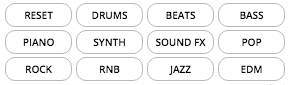
  With the Soundtrap Edu account, students have access to a huge loop library.  Loops are short snipets of sounds, (2,4,8,or 16 beats long) that have been professionally recorded and mastered and can be placed into a track and repeated as much or little as the user desires.  So far, my students are showing a great affinity for the drum and bass loops, which is great. They have a good instinct for the foundational aspects of music creation.  There are many many more loops to play with, so it will be interesting to see how they use them.  Here is a screenshot of the loop categories:
Each of these categories contains many many loop choices. So far my students have focused on DRUMS, BEATS and BASS loops. 
  Although they are creating wonderful sounding pieces, they are all no more than 8 or 16 measures and there is no harmonic movement.  There is also very little in the way of structure, just a wall of loops stacked on each other.  Here is another screenshot where you can see the student started right out of the gate stacking loops for 8 measures. I actually extended the piece and put in some sound FX and a heavy "4 on the floor" loop (in green), to elevate the original idea and begin to create some shape (just sharing the picture here, no audio):

3. Moving forward - First lesson ideas, structure and harmony.

  So being one week in, I am already getting an idea of how I can not only provide the students with this amazing tool, but also guide them through a process of creating a song that has complex structure and some harmonic movement.  Here are some ideas:

Mapping Music Lesson:
  Have the students pick a favorite song, map out the basic structure, then apply that structure to their piece.  Here is an example that a student mapped out of one of her favorite songs (the numbers on the right are the length in measures). 
  She then took this map to Soundtrap.com and began creating loops that matched the length of each part.  She decided that 12 measures was too long for the verses, so she shortened them to 8, which is great, all part of the process of taking ownership.  The key: She is not making a replica of her favorite song, she is just using the skeleton to create something totally new.

Chord Progression Lesson:
  Earlier in the year I gave some lessons on popular chord progressions, I-IV-V-I and the like.  Some of my middle school students took these lessons to Noteflight.com (incredible free online music notation software) and wrote some melodies to lay over these simple chord progressions.  We then exported the written music as a .MIDI file.  I found that if you rename the file to a .MID (take away the I), you can simply drag and drop them into Soundtrap!  The different voices in the score automatically became separate tracks, which we could then assign different instruments and sounds to.  It also imported all the tempo and key data, which meant we could then add loops and really bring the music to another level. 

  As an added bonus, (which I did not see coming)...When the student played the enhanced piece for the string orchestra they immediately asked if they could play it at the next concert.  So she printed off the parts and now we will be performing the piece. She will also release the studio version on the next School album!! 

You can visit http://golikethewindmusic.bandcamp.com to hear the last 10 years of original student work from my students at Go Like The Wind School in Ann Arbor, MI.  It is already apparent that Soundtrap.com will play a huge role in the next album set to release in June.  I could not be more excited, and there is so much more to explore!!

Thursday, August 06, 2015

NYU IMPACT Conference 2015 - Summary and Reflection

What is IMPACT?

 The annual Interactive Multimedia Performing Arts Collaborative Technology (IMPACT) Conference held at New York University just wrapped up it's second year and I was very fortunate to have been both a participant and presenter. This conference is the brainchild of Dr. Alex Ruthmann, an alumni of the University of Michigan (Go Blue!), and the creator and current director of the MusicEDLab at NYU. If I had to sum up this conference in one sentence I would say it is a gathering of very diverse (yet like-minded) individuals that want to learn about, share, discuss and understand the current state of music making as it relates to education, technology and creativity. 

Overall Summary

  The underlying current that seemed to permeate the entire experience was empowering students to create in a meaningful and profound way. This idea comes in many forms...composition, improvisation, production, recording, notating, engineering, making, hacking and so on...and it is not just an idea to be applied to music alone. As the conference went on, it was clear to me that this was not just about providing students with the tools and opportunities to be creative in music. Strong arguments, coupled with actual real-life examples served to highlight a very important point...as students learn to embrace the many facets of their own creative process, they become self aware and empowered. Fear of the unknown is replaced with a desire to identify problems and solve them.  This mindset goes well beyond music making and can transform the way individuals interact with the world, empowering them to find ways to make the world a better place.  I am beyond inspired.

Highlights - Welcome Reception

  At the welcome event on Wednesday evening the first person I talked to was Frederik Posse from Soundtrap.com, he was there with one of Soundtrap's developers Ashkan Fardost. They were both very passionate about the idea of simplifying the creative process of music making for beginning music makers. After trying it out and creating a tune in less than 2 minutes, I can tell you they have done a really fabulous job. Huge loop libraries, the ability to collaborate and share projects, and even in-app video chatting. I came away very impressed. What was just as impressive was the way they listened to feedback from participants and even made changes to the software in real time. 
  
  The next highlight was touring "the house that Alex built". Dr. Alex Ruthmann has created an incredible niche within the NYU Steinhardt Music School called the MusicEDlab, (ED= 'Experience Design'). The work of the students and faculty in this school is really what IMPACT is all about...innovating new experiences with music production, education, and understanding. What was even more apparent to me however was the collaborative aspect. Just meeting the conference attendees, it was apparent that what was happening at IMPACT affected many facets of the creative world, not just music.  On just the first night I met a business man, visual artist, record producer, multiple college professors, software developers and students. Actually, because of the nature of the work, it became difficult to tell which projects belonged to the professors and which came from the students.  


Highlights - Day 1

  The first day of sessions kicked of with a keynote address by Dr. Kate Stone from Novalia.com. Her work with paper MIDI was very interesting. They have found a way to print conductive ink to create paper that can generate sounds with just a touch.  The highlight was the virtual DJ scratch turntable!

  Of coarse a personal highlight of mine was having the privilege to present my work at Go Like The Wind School. My session was titled Curating a Creative Culture. I focused on my philosophy regarding creating music as well as an overview of 10 years of projects created by GLTW students. I always have a blast presenting on the creative projects by my students and to do it in front of such a like-minded and creative group was a real honor. Not to mention the facilities were state of the art! 

  As soon as my session was over, (whew), I dove in to as many presentations as I could. The first was by Adam Bell and it was a hands-on demo of a game he called FX Roulette, which was a very creative way of teaching people how to use and explore Effects Plugins, which are basically programs that add sound and character to existing audio, such as delay, echo and reverb.  What I thought was particularly cool about this presentation was the Roulette Wheel he created to choose the FX and how easily all the participants could get in on the game using our own computers with Soundtrap. We were all up and running in less than 10 minutes with all the effects built in to the program.  The time flew by.
  
 After lunch was a group discussion with nearly every presenter and participant sitting in a big circle and discussing a wide array of topics including the use of popular music in the classroom, assessment of creative projects, and what place technology has in teaching music.  The camaraderie and conversations surrounding these discussions was perhaps the most stimulating part of this conference. Before the discussion I struck up a conversation with Matt McLean, the director of the Young Composers and Improvisers Workshop. He shared his incredible work with getting young students to compose using noteflight.com and then having their compositions played by professional musicians. The best part is that he has figured out how to make his program function as an amazing free resource for New York Public Schools. His enthusiasm for creating music with students is infectious!

  That evening we were all treated to discounted tickets to see a mind-blowing off-broadway performance called Fuerza Bruta. Without giving it away....all I can say is that it is a wonderful assault on the senses. There was no sitting, everyone was standing much like a rock concert, except the stage was the entire building from wall to wall and floor to ceiling, they used the entire space to create beautiful and artistic performance art complete with intense club-style music and very intricate lighting. I highly recommend it!

Highlights - Day 2

  The keynote speaker for day 2 was Stephania Druga, the founder of HaKIDemia, a global foundation with a mission to enable creative making for a social impact. For me, her keynote made clear the significance and power of creative thinking as a globally understood concept.  In all of her world travels, with all the language and cultural barriers, she and her team have been able to get students from everywhere thinking creatively and very effectively about real solutions to real problems that affect their communities. It was also great to see how much of her work involved music and sound. It really hit home that music really is a universal medium for communication.
  From there I was lucky to find myself in a session with Ethan Hein, a very passionate and enthusiastic music educator and musician who helped create the MusEDlab.  His session was a hands-on demonstration of a classroom activity that involved students creating music using any common medium, (in our case we used Garage Band). Once we got our pieces started, we had to switch computers and work on our neighbors music, developing it in any way we like.  We kept rotating until we made it back to own computer to see the result.  I must say, although I consider myself an expert on Garage Band, this lesson really helped me develop my computer skills and think fast.  It was all about making quick decisions in a small amount of time and executing them efficiently.  
  My favorite part of the session was how Ethan kept asking what we all thought could be done to make this better. It is that constant give and take of ideas that characterizes this conference. The result is that everyone in the room is treated like we are all on an equal pedestal. We come together for however long we have to put our heads together to make something better than it was before. Simple, effective and a great example for how we should be teaching.
  We gathered again in the afternoon for a group discussion and with everyone having been fully immersed in the IMPACT experience, the conversation became even more broad in scope. One participant posed the simple question "Why are we teaching music?". The responses led us down some very interesting paths. Barbra Friedman gave some great resources on the topic including a reference to the Evan Tobias article Hybrid Spaces and Hyphenated Musicians, as well as the work being done on musiccreativity.org.  Other educators in the room put it out there that musicians just want their music to be heard, implying the importance of students having the ability to create music that is there own.  From there we went into the many facets of creating, producing and crafting music. Jesus Florido shed light on the current struggles that the Grammy folks are having in defining the category of electronic music. The multiple perspectives and point-of-view's in the room was impressive, informative and very encouraging to a teacher that loves to create music with their students!

  The rest of the afternoon I spent sewing.  Yes I really mean sewing with a needle and thread, only this thread was conductive and the sewing was akin to laying out a circuit board on fabric. The session was with Ryan Beldsoe and it involved making fabrics that could do cool stuff like make lights light up and make music play.  It was fascinating, fun and added yet another avenue in the world of music creation that I can use to engage students, collaborate with artists and explore new creative possibilities.

  That evening it was time to get social!  The IMPACT crew set up food, drinks, music and to top it off...a multimedia jam session in the Black Box theater at NYU lead by John Crawford, associate professor of Dance and Media Arts at UC-Irvine.  We ate, drank and then wandered into the theater to play music and dance. There was a camera set up that processed the images it took and projected them on a screen in many artistic and interesting ways. People really got into it. It was a fun creative break from all the talk.

Highlights - Day 3

  Day 3 opened up with a keynote address by Adam Goldberg. He presented on his use of the iPad as a performance instrument. He showcased his use of iPads with his special needs students and the results were very beautiful. I have had students use iPads for performance when they have injured themselves and it has worked great as a substitute for their regular instruement. Adam has taken it to a whole other level. The video's he showed really say it best:
  Perhaps the sweetest experience of the conference came in the first session of the last day. It was with the husband and wife team of Francesco Banchini and Maria Elena Berardi. He is a musician and she is an historian from Italy that teach in Kenya, Africa.  What they found when they showed up for work on the first day was absolutely no modern technology to use and create with. All they had was a loop pedal that Francesco had brought with him.  Their situation got them thinking about the use of technology for teaching music and how to create "musical thinkers" with whatever was materials were hand and available.  
  During the session they walked us through a unit of study that examined pre-historic, medieval, and modern time periods and got us thinking about how music and movement were approached in these times. We then split up in to the three respective groups and created a piece of music in 10 minutes together.  I was in the pre-historic group and all we got were wooden sticks. As the music making among the three groups started, the room we were in became much too loud to work in, so we stepped off into the room next door, which happened to be a multi-million dollar audio studio control room. There we were...considering the most primal forms of communication in one of the most modern rooms on the planet.  We came up with a composition and performed it in front of the group 10 minutes later.  I felt bonded to my group, and also more in touch with the creative spirit, regardless of the tools available. Spirit nourished!

  The next session was all about Hip Hop music, turntable mixing, live sampling and the new age of mixing using software and digital audio files.  Dr. Thomas Malone took us through the history of Hip Hop and really did a great job of framing it as a very established art form worthy of a well rounded music education. He also demonstrated how this can be taught hands-on using modern technology to have students do beat mixing using a USB turntable.  It was SO much fun and I always love to see someone so passionate about their work.  I had my turntable on order before leaving the session!

  Last but not least, the conference ended where it began, hanging out with the guys from Soundtrap.com.  This time they were presenting the full features of their software by creating a song that started with some loops, then they contacted some musicians in Sweden to add some tracks live as we watched. It was pretty impressive how, in a matter of about 15 minutes, the song had two new tracks from each of these musicians on it.  Effects were added and the song was near complete.  They spent much of the time as they had the entire weekend, asking for suggestions and taking notes.  It will be fun to watch this software develop and get better over time.

 Final Thoughts

  It has been just a few days since I got back and I am already working on implementing much of what I learned at this conference into my lesson planning for next year.  The most significant take-a-way is the idea that learning to create is a process common to all human beings.  At it's best, being creative is a process of identifying both the problem and the audience for the problem and then work with that audience to find a solution. Creativity can be applied to every aspect of every life. Working within the medium of music allows us a unique opportunity to hone our creative process to find the solutions that resonate within us as individuals and reflect ourselves.  Creating new music provides profound insight into our values, our culture and our community. 

Wednesday, July 23, 2014

Four World Music Lessons - Lesson 4 - Indian Classical Music: Raga, Tala and Drone

Lesson 4 - Indian Classical music: Raga, Tala and Drone
Overview
The classical music of India is a tradition spanning thousands of years. This lesson will involve a brief description of some basic elements of Indian classical music including raga, tala, and the use of the drone.  Students will then create music using these elements.

Introduction
Video: Pandit Ravi Shankar and Ustad Allah Rakha at the Monterey Pop Festival - http://youtu.be/DO9uloP2nzA?t=5m22s

Lesson
Group Lesson
I. Drone - The foundation from which the music is born.
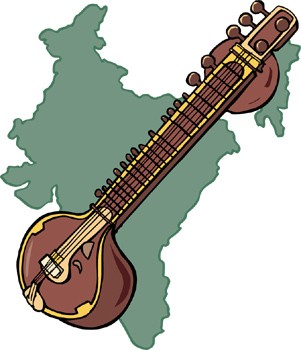
A. Tanpura - Demonstrate with live tanpura
B. The I and V drone, (vadi and samvadi)
II. Rag - Sing: Sa Re Ga Ma Pa Da Ni Sa
III. Tal - The rhythmic cycle
A. Tintal - 16 beats,
    Dha Dhin Dhin Dha
    Dha Dhin Dhin Dha
    Dha Tin   Tin    Ta
    Ta    Dhin Dhin Dha
B. Rupak Tal - 7 beats
    Tin   Tin Na
    Dhin Na
    Dhin Na

Individual or Group Work, (no more than 3 to a group)
I. Create a piece of music that  includes the following elements:
A. A drone that runs throughout the piece.
B. Instrumental melody, (vocalizations of the syllables are fine, but no lyrics
    please).
C. Melody follows the notes of a rag, (yemen, baihrav or another one of your choice).
D. Percussion keeps the tal, (rhythmic cycle). Please choose from tintal or rupak
II. Present your music to the class with the following information:
A. Rag name
B. Tal
C. The process of creation.

Advanced Work
I. Organize a lunch time concert where you present/perform your music for the Upper Elementary class.
II. Transcribe your piece of music on noteflight.com
III. Go see a live Indian classical music performance and report on it.

Resources

http://chandrakantha.com/ - David Courtney’s website, a great resource for Indian music knowledge.

Four World Music Lessons - Lesson 3 - Reggae

Lesson 3 -  Reggae
Overview
Reggae is a style of music that was developed in the 1960’s from Jamaica.

Materials - Internet access

Lesson

Individual work
I. Use any resource available and respond, (in full sentences) to at least two of the
  following items:
A. What two styles of music did reggae come from?
B. Name at least 3 pioneers of the reggae style.
C. In what decade was reggae developed?
D. What are some important musical elements found in reggae?
E. Name the common instruments found in a reggae band?
II. Create a youtube playlist of some well known reggae artists.

Group Work
I. Choose one song from the list to work with:
A. ‘Stir it up’ - Bob Marley - http://youtu.be/eZ3eA5gxiLs
B. ‘Jamaica Nice’ - Yellowman - https://www.youtube.com/watch?v=i11zpqkmupg
C. ‘Blackheart Man’ - Bunny Wailer - http://youtu.be/zjtYKPC58tg

II. Listen to the song as a group and gather information for a report on the song. Your
   report must include the following information, you may add more information to your
   report if you like, but this is what is required:
A. The tempo
B. The drum-set rhythm, (be able to count it as a group).
C. The rhythm of the guitar.
D. The overall form of the music.
E. The lyrics
F. Name of the artist, song, and all the instruments in the band.

III. Report/Presentation
A. Presentations will be done as a group, participation from all group members is
    required.
B. Presentation must not be longer than 10 minutes, or shorter than 3.
C. A group discussion will follow all presentations.

Advanced Work
I. Choose a reggae song and perform it live for the class. This can be done as an
  individual or group.
II. Transcribe a reggae song on noteflight.com and share it with the class.

III. Go see a live reggae band/artist and report on the show.